
The old playbook of global expansion without an Employer of Record services model is dead.
Five years ago, if a company wanted to hire a team in Nigeria, Brazil, or the Netherlands, the process was extremely tiring and demanding. It involved several months of legal paperwork to establish a foreign subsidiary, $100,000 in sunk legal fees, and a permanent headache of maintaining a local board of directors.
In 2025, that timeline has collapsed from several months to days.
The “mobility disruption” of 2025 has fundamentally changed how multinational businesses operate. Remote work is no longer just a perk; it is the primary economic engine for agile companies. But as borders dissolve for talent, compliance is becoming stricter. Governments have caught up, and the “wild west” era of digital nomad hiring is over.
This shift has graduated Employer of Record services from a temporary fix for freelancers to the default operating system for global business. In this article, we break down the financial, legal, and operational reasons why 90% of high-growth companies will choose the EOR model over entity setup in 2026.
What Are Employer of Record Services? (And What They Are Not)
An Employer of Record (EOR) is a third-party organization that becomes the full legal employer of your workforce in a specific country. While you retain 100% control over the employee’s day-to-day tasks, projects, and management, the Employer of Record services handles the “boring” (but risky) administrative side:
- Local employment contracts
- Payroll processing and tax withholdings
- Statutory benefits (pension, health insurance, social security)
- Visa and immigration sponsorship
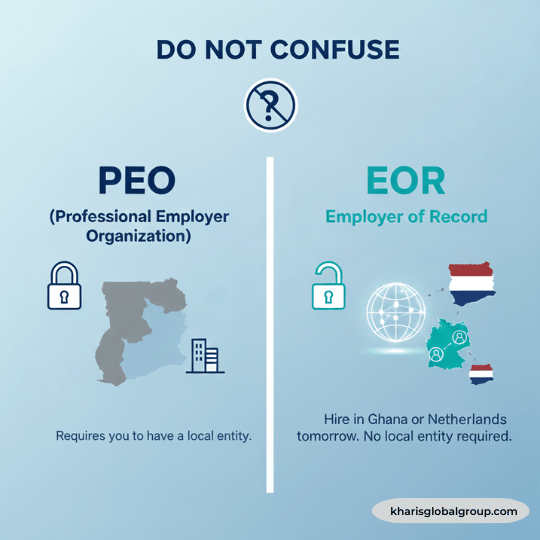
Important Distinction: Do not confuse an EOR with a PEO (Professional Employer Organization). A PEO generally requires you to already own a local entity in that country. While with an EOR, you can hire in Ghana or Germany tomorrow without owning a single piece of paper there.
3 Reasons EOR is the “Default” for 2026
Why are both Fortune 500 companies and startups switching to this model? It comes down to three factors: Velocity, Shielding, and OPEX.
1. Velocity: Speed to Market is the New Currency
In the current economic landscape, market windows close fast. If you identify a demand for your product in West Africa, waiting 6–12 months to incorporate a local company means you have already lost.
Employer of Record services allow for “instant” market entry. You can interview a candidate on Monday and have them legally onboarded and working by Thursday. This agility will enable businesses to test new markets with zero friction.
2. The Compliance Shield
Regulatory divergence is rising. As labour laws in the EU, Africa, and Asia drift further apart, maintaining an in-house legal team for every single jurisdiction is financially impossible for most firms.
When you use an EOR, you are outsourcing the liability. If there is a payroll audit or a change in local labor laws (like the recent Ghana Tax Reforms), it is the EOR’s responsibility to solve it, not yours. They act as a “compliance shield,” absorbing the regulatory blows so your team can focus on strategy.
3. Cost Flexibility (CAPEX vs. OPEX)
Setting up a subsidiary is a massive Capital Expenditure (CAPEX) that requires heavy upfront investment in legal retainers, bank deposits, and office leases.
The EOR model shifts this to an Operating Expenditure (OPEX). You pay a monthly fee per employee. This flexibility is crucial for CFOs in 2026, allowing companies to scale their workforce up or down without being anchored by sunk costs.
The “Niche Specialist” Trend: Why Generalists Are Losing Ground
A major trend we are seeing for 2026 is the move away from “massive generalist” EORs toward Regional Specialists.
In the early 2020s, the goal was to find one provider who claimed to cover 190 countries. However, businesses quickly realized that a provider based in San Francisco likely lacks the deep, on-the-ground knowledge required to navigate the complex bureaucracy of Nigeria or the United Arab Emirates.
Why Specialization Matters:
- Accuracy: Generalists often use “white-label” partners, diluting control. Specialists own their entities.
- Speed: A specialist in African markets, for example, will have direct lines to local immigration officers, speeding up visa processes that generalists might stall on.
- Culture: HR is local. Knowing how to handle a culturally sensitive termination or a customary bonus dispute requires local DNA, not a global algorithm.
Tech + Human Touch: The New Standard
Finally, the Employer of Record services of 2026 are defined by a hybrid of AI and human expertise.
- AI for Efficiency: Modern EOR platforms use AI to instantly calculate net-to-gross salary conversions, predict visa processing times based on current embassy loads, and flag potential contract risks in real-time.
- Humans for Strategy: Technology cannot explain why a visa was rejected or negotiate a delicate severance package. The “Human in the Loop” remains essential.
The best providers offer a dashboard for the data, but a dedicated Account Manager for the decisions.

The 2026 Landscape: Why “Hiring Globally” Changed Overnight
To understand why the EOR model is winning, we first have to look at the macro environment of 2025. Two massive forces are colliding: a severe talent deficit in the West and a compliance wall globally.
1. The Global Skills Mismatch
Western markets (North America and Western Europe) are facing critical aging populations and skills gaps, particularly in tech and engineering. Meanwhile, growth markets specifically in Africa, Latin America, and Southeast Asia are experiencing a “youth boom” with a surplus of highly skilled, English-speaking talent.
According to recent data, the global talent shortage is projected to result in an $8.5 trillion loss in unrealized revenue by 2030 if left unchecked. Companies can no longer afford to hire only within a 50-mile radius of their HQ.
2. The Compliance Wall
The days of hiring a remote worker as a “permanent contractor” to avoid taxes are over. In 2026, tax authorities worldwide have implemented stricter frameworks, such as the Global Minimum Tax adjustments and digital nomad visa crackdowns, to ensure they capture revenue from remote workers.
Using Employer of Record services is no longer just about convenience; it is about survival. It is the only scalable way to access global talent without triggering tax evasion penalties.
Conclusion: The Future is Borderless
The distinction between “local hiring” and “global hiring” is evaporating. By 2030, analysts predict that “owning an entity” will be a strategy reserved only for a company’s HQ and primary manufacturing hubs. For knowledge work, sales teams, and support staff, the Employer of Record services model will be the absolute standard.
It allows you to be a citizen of the world without being a victim of its bureaucracy.
Don’t let paperwork be the bottleneck that strangles your growth. The talent is out there waiting for you to make the move.
Ready to Expand Without the Headache?
Stop worrying about compliance fines and start focusing on your business effectiveness. Whether you need to hire a single developer from India or a full sales team in Nigeria, we can deploy your workforce in 2 – 7 working days.
[Calculate your expansion costs today with our Free Consultation]