

Category: Human Capital Management
Date: May 19, 2026 | Read Time: 6 min
Table of Contents
- What is a Professional Employer Organization (PEO)?
- Three Common PEO Challenges — And the Kharis Solution
- Is a PEO Right for Your Business?
- Final Thoughts
Scaling a business across borders is one of the most exciting (and operationally complex) challenges a leader can face. Managing payroll, compliance, benefits, and HR administration in multiple jurisdictions can quietly become the bottleneck that holds your growth back. That’s where the Professional Employer Organization (PEO) model enters the picture.
In this post, we break down exactly what a PEO is, why global businesses increasingly rely on them, (and critically) how to choose a partner that doesn’t trade control for convenience. We’ll also walk through three real friction points that organisations encounter with standard PEO arrangements, and how Kharis Global Group is built to solve them.
A PEO is an external partner that enters into a “co-employment” relationship with your business. You retain full control over day-to-day operations and hiring decisions, while the PEO assumes legal responsibility for back-office HR tasks; payroll, tax compliance, benefits administration, and workers’ compensation.
Think of it as outsourcing the administrative “heavy lifting” of human resources, without giving up oversight of your people or your culture. According to the National Association of Professional Employer Organizations (NAPEO), businesses that use PEOs grow 7–9% faster and have 10–14% lower employee turnover than those that don’t.
- 7–9%: Faster growth for PEO-backed businesses.
- 10–14%: Lower employee turnover on average.
- 4x: ROI estimated for every $1 spent on a PEO.
The case for PEOs is compelling. But not all PEOs are created equal and the wrong choice can introduce the very problems you were trying to solve.
Three Common PEO Challenges — And the Kharis Solution
Even with a quality PEO in place, businesses frequently hit friction points. Here’s where standard providers often fall short, and how Kharis Global Group approaches each differently.
CHALLENGE 01: The “Loss of Control” Anxiety
Many business leaders fear that handing HR functions to a standardised PEO will dilute company culture or sever their direct oversight of team data. When a provider applies a rigid, one-size-fits-all policy framework, that fear is often justified.
The Kharis Solution: Kharis Global Group takes a bespoke, client-centric approach. Rather than forcing businesses into a pre-built HR template, Kharis aligns its strategies with your specific values and operational context, ensuring you keep the “human” element of your HR while they manage the technical administration. Learn more about what to look for in a PEO relationship via SHRM.
CHALLENGE 02: Complex Global and Multi-Jurisdictional Compliance
Standard PEOs often excel in a single country but struggle to support businesses with international footprints. Maintaining compliance across different borders, labour laws, and immigration requirements is a specialised discipline — and the penalties for getting it wrong are severe. The ILO estimates that labour law violations cost businesses billions in fines and reputational damage annually.
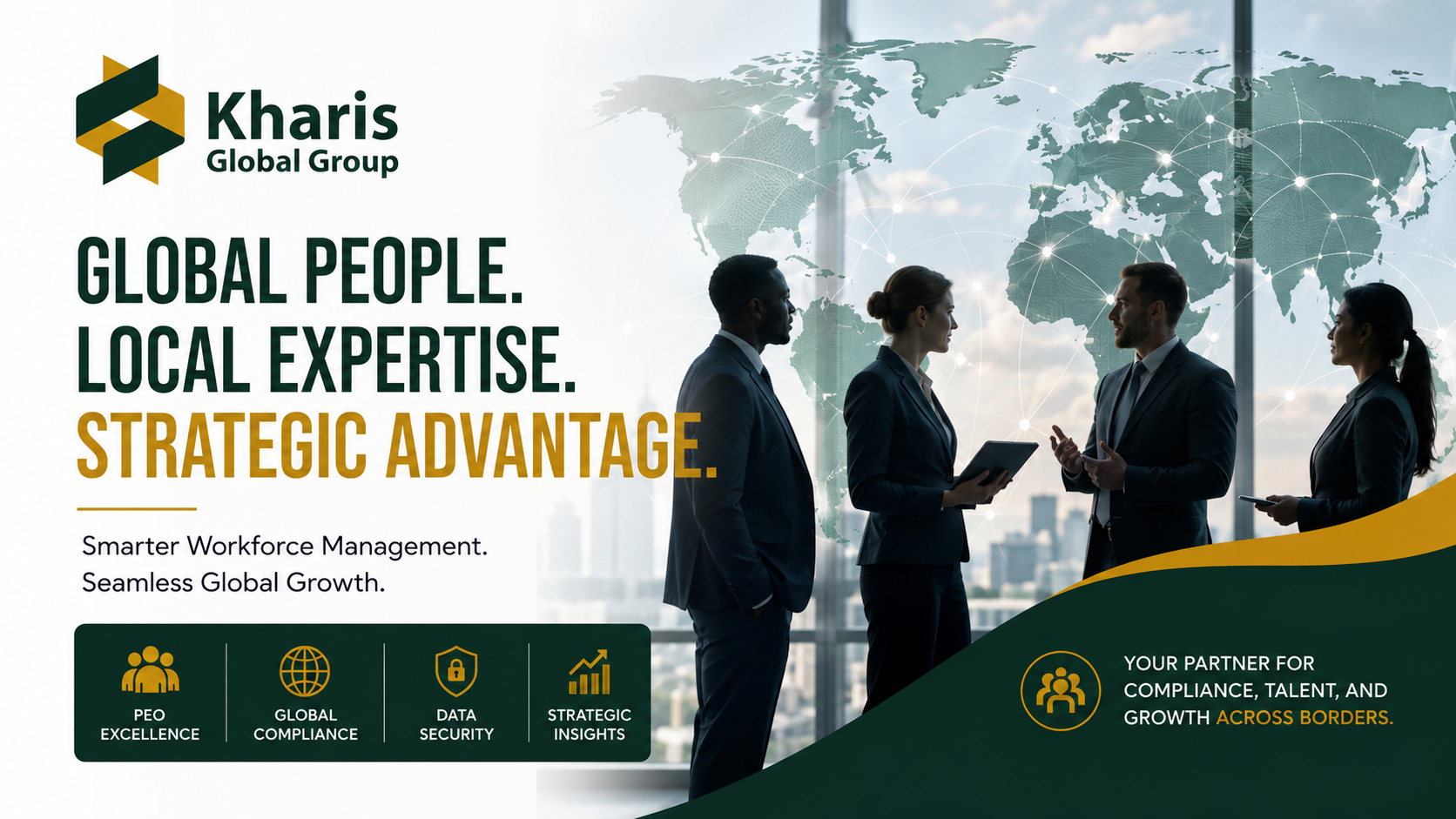
The Kharis Solution: Kharis Global Group specialises in multinational operations across Africa, the UK, the USA, and the UAE. Their “solutions hub” model manages the legal complexities of immigration, global staff management, and local tax compliance allowing elite companies to scale across borders without fear of regulatory intervention.
CHALLENGE 03: The Data Disconnect
When HR data lives outside the organisation, leadership often struggles to access timely, accurate workforce insights. This opacity makes strategic decision-making reactive rather than proactive; a significant disadvantage in competitive markets. According to Gartner, only 15% of HR leaders say they can reliably use workforce data for strategic planning.
The Kharis Solution: Kharis integrates pragmatic, technology-driven administrative support that prioritises transparency. By treating every client’s business as if it were their own and upholding rigorous data protection standards, they ensure that sensitive HR information remains accessible, secure, and actionable for strategic planning.
Is a PEO Right for Your Business?
The PEO model is especially powerful for businesses that are scaling rapidly, entering new markets, or managing employees across multiple countries. It may be time to explore a PEO partnership if:
- Your HR team is spending more time on compliance than on people strategy.
- You’re entering a new country and don’t have established legal entities yet.
- Employee benefits are becoming difficult to manage or competitively uncompetitive.
- Regulatory changes in your operating regions are creating uncertainty.
- You want to hire globally without setting up a subsidiary in every jurisdiction.
The World Bank’s Jobs and Development Programme consistently highlights that administrative and regulatory burdens are among the top constraints on business growth in emerging markets; precisely where a capable PEO partner adds the most value.
Final Thoughts
The right PEO doesn’t just take work off your plate, it becomes a strategic asset. But the operative word is right. The most common PEO pitfalls; loss of cultural control, fragmented multi-country compliance, and data opacity — are entirely avoidable with a partner that combines global reach, local expertise, and a genuine commitment to your business outcomes.
Kharis Global Group was built precisely for organisations that refuse to choose between scale and control. Whether you’re managing a workforce across Africa, navigating UK employment law, or building a team in the UAE, their cross-border solutions hub is designed to remove friction at every step.
Are you experiencing a specific pain point in your workforce management — in a particular region or at a particular stage of growth?