
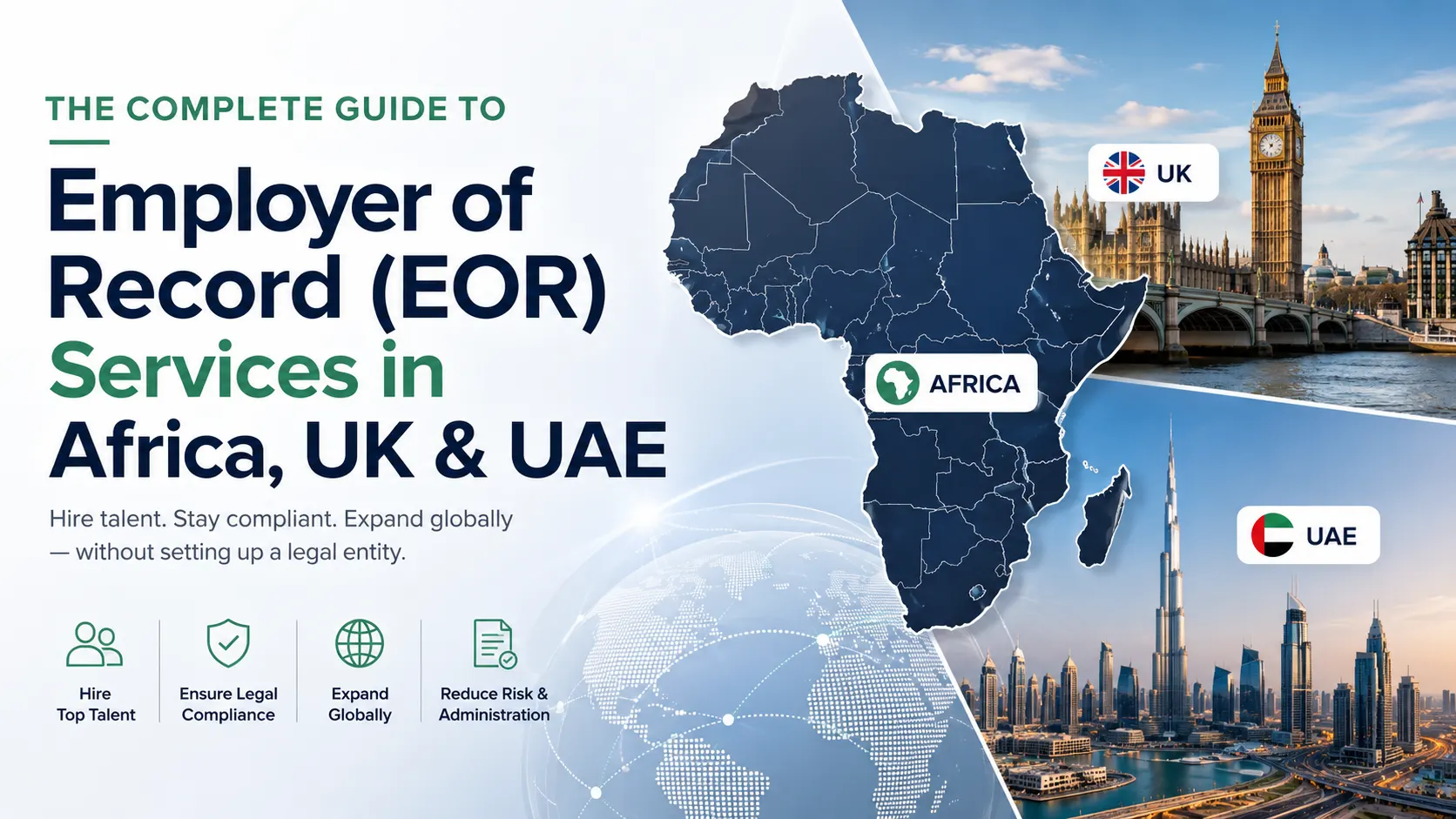
Expanding a workforce across borders has never been more commercially urgent or more legally complex. Whether you are an international NGO deploying staff in West Africa, an energy company managing rotational crews in Ghana’s upstream sector, or a UK-based firm onboarding remote talent in Nigeria, the fundamental challenge is the same: how do you employ people compliantly in a country where you have no legal entity? An Employer of Record (EOR) services solve that problem precisely.
1. What is an Employer of Record (EOR)?
An Employer of Record is a third-party organisation that becomes the legal employer of a worker in a given country on behalf of another company. In practical terms, the EOR signs the employment contract, runs the payroll, deducts the correct taxes, administers statutory benefits, and ensures full compliance with local labour law, while your company retains complete control over the employee’s daily tasks, responsibilities, and performance.
Think of it as separating the administrative and legal burden of international employment from the operational reality. You manage the work; the EOR manages the paperwork, the risk, and the compliance.
| Key distinction The EOR is the employer on paper. You are the employer in practice. This distinction is important: it means you gain a compliant, fully onboarded employee in a foreign country without registering a legal entity, waiting months for regulatory approvals, or navigating unfamiliar employment legislation alone. |
The EOR model is particularly powerful in markets where regulatory complexity, local content requirements, or the absence of a straightforward company registration process would otherwise make international hiring prohibitively slow or risky. Across sub-Saharan Africa, the Gulf Cooperation Council (GCC), and in the post-Brexit UK, these conditions apply to a significant number of expansion scenarios.
2. How EOR services work — step by step
When a company engages an EOR provider, the arrangement follows a clear and repeatable process. Here is how Kharis Global Group structures each engagement:
1. Engagement and scoping
You share details about the role, location, compensation structure, and any specific statutory requirements. We confirm feasibility, compliance requirements, and timelines for the target country.
2. Employment contract drafting
Our legal and HR teams prepare a locally compliant employment contract reflecting the agreed compensation, benefits, leave entitlements, and termination provisions under the relevant labour law.
3. Work permit and immigration
For expatriate hires, we coordinate the full immigration process in parallel with onboarding including quota applications, work permit submissions, and entry documentation.
4. Payroll setup and registration
We register the employee with relevant statutory bodies such as Ghana’s SSNIT, Nigeria’s NSITF, or the UAE’s WPS, and configure payroll to run correctly from day one.
5. Ongoing payroll, compliance, and reporting
Monthly payroll is processed, payslips are issued, statutory deductions are remitted on time, and all regulatory filings are handled. You receive consolidated reporting, so your finance team always has full visibility.
6. Offboarding and exit management
When the engagement ends, we manage the legally compliant termination process, final settlements, permit cancellations, and de-registration from statutory bodies, ensuring no residual liability remains.
| 2–14 | 3–6 | 10+ |
| business days to onboard via EOR | Months to set up a foreign subsidiary | Countries where Kharis operates |
3. EOR vs PEO vs foreign subsidiary
Three models dominate international workforce expansion. Understanding the distinctions and where each one breaks down is essential before committing to a structure.
| Criteria | Employer of Record | PEO (Co-employment) | Foreign Subsidiary |
|---|---|---|---|
| Borne by the client | EOR (fully) | Shared between PEO & client | Client company |
| Speed to hire | Days to 2 weeks | 2–4 weeks | 3–6 months |
| Compliance liability | Borne by EOR | Shared | Market testing, project teams, and expatriate staffing |
| Entity registration required | No | Sometimes | Yes |
| Available in West Africa | Yes | Limited | Yes (slow) |
| Market testing, project teams, and expatriate staffing | Yes | Varies by free zone | Yes (costly) |
| Upfront cost | Low | Moderate | High |
| Best suited for | Market testing, project teams, expatriate staffing | Established US & EU markets | Borne by the subsidiary |
| Important note on PEOs The Professional Employer Organisation (PEO) model is legally recognised and well-established in the United States, Africa, and parts of Europe. This means that companies attempting to operate a co-employment structure in parts of Europe where it is not legally recognised could face significant compliance ambiguity. The EOR model, by contrast, operates on a clearly defined legal basis in each country globally. |
4. Key benefits of using an EOR
The strategic and operational advantages of the EOR model extend beyond simple cost reduction. Here are the factors that consistently drive companies toward EOR solutions:
Compliance by design
Labour law, payroll tax, and statutory benefit obligations are handled by specialists with in-country expertise. Penalties and legal exposure sit with the EOR, not your business.
Speed to market
From signing an EOR agreement to having a compliant, onboarded employee in-country can take as little as five business days compared to months for a subsidiary setup.
Cost efficiency
No registration fees, no local legal counsel retainers, no ongoing entity maintenance. EOR converts a large, unpredictable capital cost into a predictable per-employee fee.
Workforce flexibility
Scale headcount up or down in response to project cycles, demand fluctuations, or strategic pivots — without the overhead of maintaining a permanent legal structure.
Local expertise, global reach
A trusted EOR partner combines on-the-ground knowledge of local customs, regulators, and HR norms with the infrastructure to operate across multiple jurisdictions simultaneously.
Expatriate management
EOR services integrate naturally with immigration support, enabling companies to deploy foreign nationals with work permits, residency, and benefits managed from a single point of contact.
5. Industries that rely on EOR services
The EOR model serves any organisation that needs to deploy people across borders, but certain sectors rely on it with particular intensity. Across Kharis Global Group’s client base, the following industries represent the highest demand:
Upstream oil and gas
Ghana and Nigeria are among West Africa’s most active upstream petroleum markets. International oil companies (IOCs), engineering firms, and EPCM contractors routinely need to mobilise specialised technical personnel, drilling engineers, HSE officers, offshore crew, and geologists on short timelines, often under local content obligations that demand in-country employment structures. EOR provides the legal and payroll backbone for these rotational, project-based workforces without requiring the IOC to establish its own Ghanaian or Nigerian entity.
International NGOs and development organisations
Multilateral development banks, UN agencies, and international NGOs frequently operate across multiple West African countries simultaneously. They need to employ country-based programme officers, field staff, and consultants in a compliant manner, without each country programme having its own registered employer. EOR is often the most workable solution.
Technology and professional services
Tech companies and consulting firms expanding into African markets often need to hire senior local talent, business development leads, market managers, and technical consultants before they are ready to commit to a permanent subsidiary. EOR allows them to move quickly and test the market with a compliant employment structure in place.
Construction and infrastructure
Large capital projects in Ghana, Nigeria, and the Ivory Coast often require international specialists to be deployed for defined project periods. EOR provides a structured employment framework for these temporary, high-value assignments.
6. EOR in Africa: Ghana, Nigeria & West Africa
West Africa is one of the world’s most dynamic emerging market regions, home to fast-growing economies, significant natural resource sectors, and a rapidly expanding consumer base. It is also home to some of the most complex employment legislation on the continent. Understanding the compliance landscape country by country is essential.
| Ghana Labour Act 651 • SSNIT • GRA | Nigeria Labour Act Cap L1 • FIRS • NCDMB | West Africa region Ivory Coast • Liberia • Sierra Leone • Togo |
|---|---|---|
| Employment governed by the Labour Act 2003 (Act 651) | Labour Act and state-level employment regulations apply | Kharis Global Group operates across the ECOWAS region |
| Mandatory Social Security contributions to SSNIT (Tier 1 & 2) | Expatriate Quota approvals are required before hiring foreign nationals | OHADA commercial law applies in Francophone West African states |
| Work permits through the Ghana Immigration Service | Expatriate Quota approvals required before hiring foreign nationals | Ivory Coast: Code du Travail, CNPS social security |
| Employers must register with NSITF, NHF, and ITF | Combined Expatriate Residence Permit and Aliens Card (CERPAC) | Liberia: Decent Work Act governs employment relations |
| PAYE remitted monthly to the Ghana Revenue Authority | NCDMB local content compliance for oil & gas sector | Sierra Leone: Employees Act and national social security (NASSIT) |
| Probationary period: up to 6 months under Act 651 | NCDMB local content compliance for the oil & gas sector | Regional expertise in managing multilingual, multi-jurisdictional payrolls |
| Local content compliance Ghana and Nigeria both have active local content legislation. Ghana’s Petroleum Commission requires minimum thresholds for Ghanaian participation in upstream workforce roles. Nigeria’s NCDMB enforces the Nigerian Oil and Gas Industry Content Development Act. Kharis Global Group has deep experience helping international operators structure compliant local and expatriate employment arrangements that satisfy these requirements. |
Country-specific guides
- Employer of record services in Ghana: a complete business guide
- Employer of record in Nigeria: compliance, payroll & hiring guide
7. EOR in the UAE
The United Arab Emirates offers a unique dual-track business environment: mainland operations governed by the UAE Labour Law, and free zone operations governed by free zone-specific authorities such as JAFZA, DIFC, ADGM, and others. This distinction matters significantly for EOR arrangements.
On the mainland, the UAE Federal Labour Law (Federal Decree-Law No. 33 of 2021) sets out the framework for employment contracts, end-of-service gratuity, working hours, leave entitlements, and termination provisions. All employees must be registered under the Wage Protection System (WPS), which mandates electronic payroll transfer through approved financial institutions. Kharis Global Group’s UAE operations ensure full WPS compliance for every employee we manage.
For companies wishing to employ staff in the UAE without registering on the mainland, free zone employment through a UAE-registered EOR entity is often the most practical route. This model is particularly popular with technology companies, consulting firms, and regional headquarters that wish to base employees in Dubai or Abu Dhabi while maintaining operational agility.
| UAE employment essentials Key statutory requirements under UAE Labour Law include: end-of-service gratuity (calculated on basic salary), mandatory medical insurance for all employees and their dependents, annual leave of a minimum 30 calendar days after one year of service, and adherence to the Wage Protection System for salary disbursement. Kharis Global Group manages all of these obligations on behalf of client companies. |
8. EOR in the UK & Europe
The United Kingdom’s employment framework is well-established, but it has grown in complexity following the introduction of IR35 off-payroll working rules, the expansion of worker classification categories, and post-Brexit changes to the right to work in the UK. For non-UK companies wishing to employ staff in the UK without registering a British entity, an EOR provides a straightforward path to HMRC compliance.
UK EOR obligations include operating PAYE under Real Time Information (RTI) submissions to HMRC, National Insurance contributions (employer and employee), statutory leave entitlements under the Employment Rights Act 1996, auto-enrolment pension contributions, and compliance with the National Living Wage. IR35 determinations must also be carefully managed for any contractor or consultant arrangements.
Kharis Global Group’s UK operations, managed from our London office, support companies across Europe who wish to build UK-based teams, as well as African and Gulf-based organisations employing UK-resident staff on international projects.
9. Immigration & work permit integration
One of the most significant differentiators between EOR providers is the ability to combine employment management with immigration support. For many international expansion scenarios, particularly in the oil and gas, infrastructure, and consulting sectors, the majority of employees being deployed will be foreign nationals who require work authorisation before they can legally commence employment.
Attempting to manage EOR and immigration through separate providers creates coordination risk: payroll cannot be set up until work permits are granted, and work permits often require proof of employment. When these processes are siloed, delays compound and compliance gaps emerge.
Kharis Global Group manages both workstreams from a single point of accountability. Our immigration specialists work in parallel with our HR and payroll teams, ensuring that work permit applications, quota approvals, employment contracts, and payroll setup are progressed simultaneously and sequenced correctly for each jurisdiction.
| Country | Permit type | Typical timeline without an EOR | Key requirement |
|---|---|---|---|
| Ghana | Work & Residence Permit | 4–8 weeks | WPS registration, medical fitness, and Emirates ID |
| Nigeria | CERPAC (Expatriate Quota) | 6–12 weeks | Expatriate Quota grant before CERPAC application |
| UAE | Employment Visa & Residence Permit | 2–4 weeks | WPS registration, medical fitness, Emirates ID |
| UK | Skilled Worker Visa | 3–8 weeks | WPS registration, medical fitness, and Emirates ID |
10. How Kharis Global Group delivers EOR
Kharis Global Group was founded in Ghana in 2013 as a fully Ghanaian-owned private company. Over the past decade, we have grown into a multinational provider of EOR, HR outsourcing, payroll management, immigration support, and contractor management services across 10+ countries on three continents.
What distinguishes our approach is not just geographic coverage. It is the combination of local legal entities, in-country compliance expertise, and genuinely hands-on client service that many global EOR platforms cannot replicate from a technology-only model.
Our operational footprint
We have active operations in Ghana, Nigeria, the Ivory Coast, Liberia, Sierra Leone, Togo, the Netherlands, the United Kingdom, Canada, and the United Arab Emirates. In West Africa, we do not manage employment remotely through intermediaries: we have established in-country legal entities and resident teams who understand local regulators, labour tribunals, and employment customs at a granular level.
Our service model
Every EOR engagement with Kharis Global Group includes a dedicated account manager, in-country HR and payroll support, monthly compliance reporting, and direct access to our immigration specialists where work permits are required. We do not operate a one-size-fits-all model: each engagement is structured around the specific compliance environment of the target country, the nature of the role, and the client’s commercial objectives.
Upstream oil and gas expertise
We have particular depth in the upstream petroleum sector across Ghana and Nigeria, having supported IOCs, EPCM contractors, and service companies with rotational workforce management, local content compliance, HSE-aligned employment structures, and specialised permit categories for technical personnel. This sector expertise is reflected in our processes, our legal documentation, and the relationships we have built with relevant regulatory bodies over more than a decade.
Frequently asked questions
What is an Employer of Record (EOR)?
An Employer of Record (EOR) is a third-party organisation that legally employs workers on behalf of another company. The EOR handles employment contracts, payroll, tax compliance, and statutory benefits, while the client company retains day-to-day control over the employee’s work.
Do I lose control of my employees when I use an EOR?
No. The EOR is the legal employer on paper for compliance purposes only. You retain full control over the employee’s daily tasks, performance management, deliverables, and working arrangements. The EOR removes the administrative and legal burden of international employment without changing your operational relationship with the individual.
What is the difference between an EOR and a PEO?
An EOR becomes the sole legal employer of record, bearing full compliance liability. A PEO operates a co-employment model where both the PEO and the client company share employer responsibilities. EOR is typically the better model for international expansion, especially in Africa, where PEO models lack a legal framework in most markets.
Can an EOR handle work permits and immigration?
Yes. Kharis Global Group uniquely combines EOR services with end-to-end immigration support, including work permit applications, quota approvals, residence permits, and dependent visas across Ghana, Nigeria, the UAE, and the UK. Managing both workstreams through a single provider eliminates coordination risk and reduces overall timelines.
How is EOR pricing structured?
EOR pricing is typically structured as a per-employee monthly management fee, which covers payroll administration, compliance management, statutory filings, and ongoing HR support. This fee is separate from the employee’s gross salary and employer-side statutory contributions. Contact us for a tailored quote based on your specific headcount, locations, and service requirements.